
By Anthony Lopez Ranger Reporter
Every year, millions of people all around the country look forward to the one day where being different is considered normal. Costumes of monsters, goblins, magic and everything in between are used to cause a night of annual mischief, but as the Halloween season continues to grow in popularity with each passing year, the history of why the autumn season is now a billion-dollar industry continues to be dismissed.
Halloween is now synonymous with commercialism, but fortunately, it was not always this way. The word “Halloween” — “Hallow,” meaning holy or having religious inclinations, and “een,” which derives as a contraction of “eve” — has roots in Celtic origins dating back as far as the
Iron Age.
The pagan holiday Samhain (pronounced “sow-in”) was a multiday celebration that honored the death and rebirth of not only the harvest season but also the loss of loved ones plagued by famine, disease and overall shortened life spans due to a lack of resources. The Celts, or “early natives” of Ireland, the United Kingdom, Scotland and other parts of Northern Europe, based a yearly calendar on a cycle that essentially recognized the transitional markings of yearly patterns.
The word Samhain has Irish origins and translates to “summer’s end.” It has a history of being controversial for the macabre undertones that are largely responsible for why Halloween is considered “evil.” Ultimately, the focus of the Samhain season was to celebrate the death of established traditions, particularly through homages and feasts that distinguished the dark truths of life coming to an end.
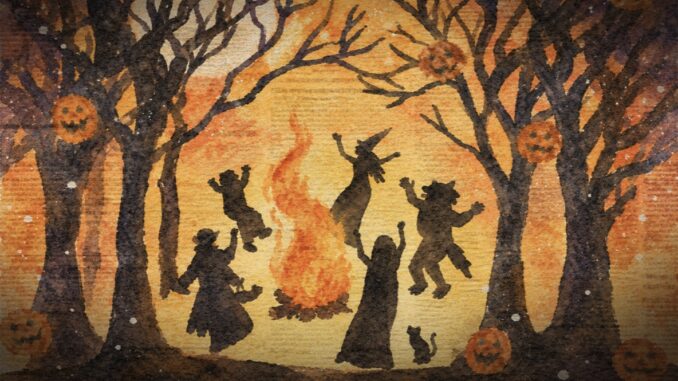
The partaking in dances around a fire was an invitation for spirits to once again rejoin the living, and although many of Samhain’s original rituals have been lost to modernity, the connection to evil spirits and scary truths has remained an essential part of
Halloween traditions.
Originally, costumes were made from animal remains and used to “hide” from unfriendly or dark spirits, but the evolution of wearing a costume on Halloween has since transformed into a fun practice used to receive candy or treats. Feasting and making lanterns from hollowed gourds seemingly gave birth to what we know now as the jack-o’-lantern, and the pattern of traditional practices observed even today all have a foundation of larger meaning.
The sacrificial rituals of crops or animals were made during this time as offerings to spirits but have seemingly been lost to time, so people think. The popularity of playing pranks or “tricks” on others was blamed on mischievous spirits but ultimately developed into current traditions such as smashing pumpkins and throwing toilet paper at someone’s residence.
Once Rome conquered the majority of Celtic land around A.D. 43, the spread of Christianity, specifically Catholicism, resulted in a forced evolution and overall oppression of established pagan traditions. Many Celtic practices were then forced to fit the growing narrative in Christian values to convert people and encourage them to be more
religiously aware.
Samhain would evolve into what is now known as All Saints’ Day, or “All Hallows’ Day.” Halloween would develop into a more secular version of All Hallows’ Eve and eventually become an even more popular holiday that was now considered to
be salubrious.
Once America saw a large increase in Irish immigrants entering the country around the mid-19th century, elements of secular harvest introduced customs and traditions that would inevitably form the early development of one of America’s favorite holidays.
Eventually, by the late 19th century, children would keep to the tradition of dressing in costumes, but this time in favor of receiving money, fruit and sometimes even prayers.
With the introduction of the 20th century, the commercialization of Halloween would finally begin to formulate. Halloween merchandise would now be marketed through watered-down versions of typical pagan practices, such as animal skins now being replaced by bedsheets or other premade costumes for not only children but adults as well.
After World War II, the economic impact of candy manufacturers had now involved products as an essential part of Halloween,
specifically “trick-or-treating.”
One of the most infatuating components of modern Halloween traditions is how film and television became largely responsible for the growth in popularity of America’s holiday as a mass-marketed celebration. Throughout the ’50s, ’60s and even ’70s, the horror genre created an interest in stimulated feelings that could be related to the older, more controversial pagan traditions.
Whether the true meaning of Halloween has been lost to time, the holiday has since drastically evolved into a funner, more widely accepted means of celebrating the end of the fall season.
Leave a Reply